Why strong vendor management matters for Colorado businesses
June 22, 2026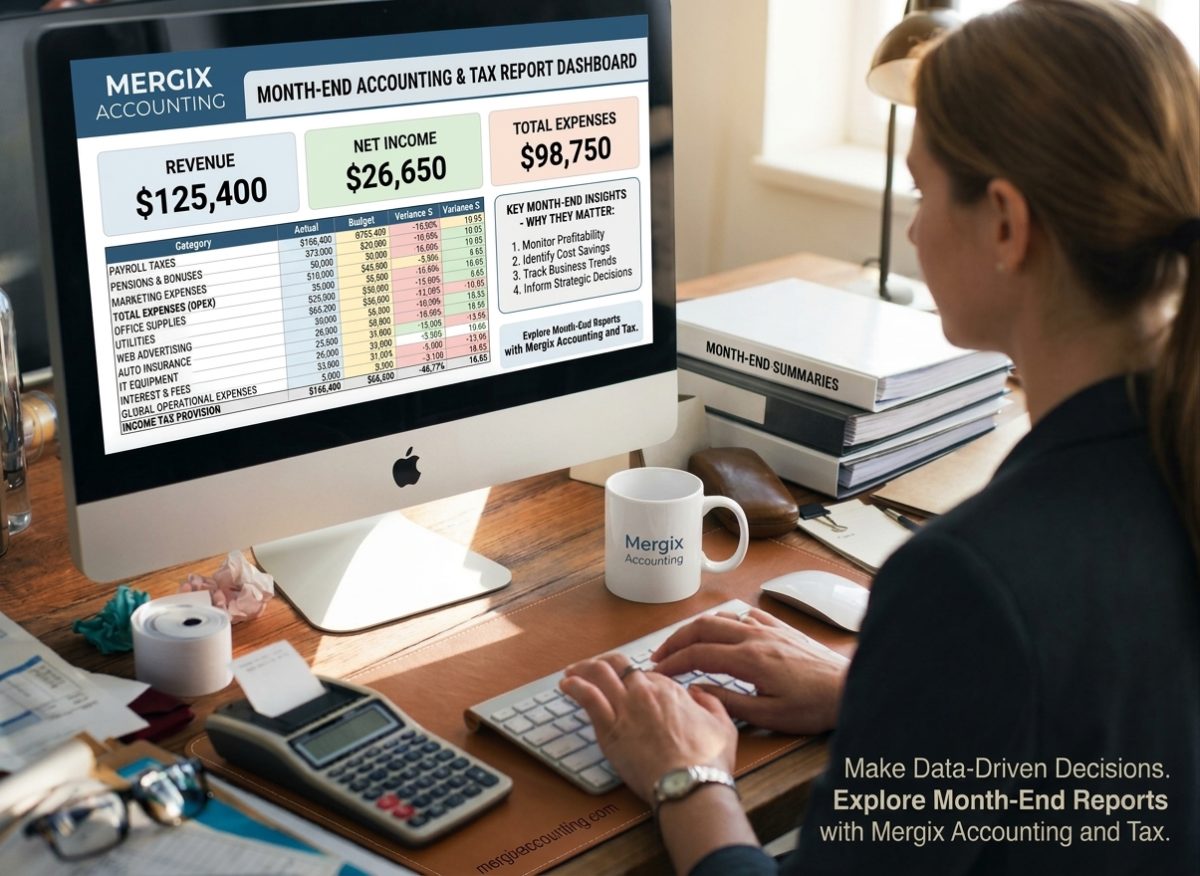
QUICK ANSWER
A month-end report is a set of financial statements and summaries prepared after closing your books at the end of each month. It shows how much your business earned, spent, owes, and owns during that period.
What is a month-end report?
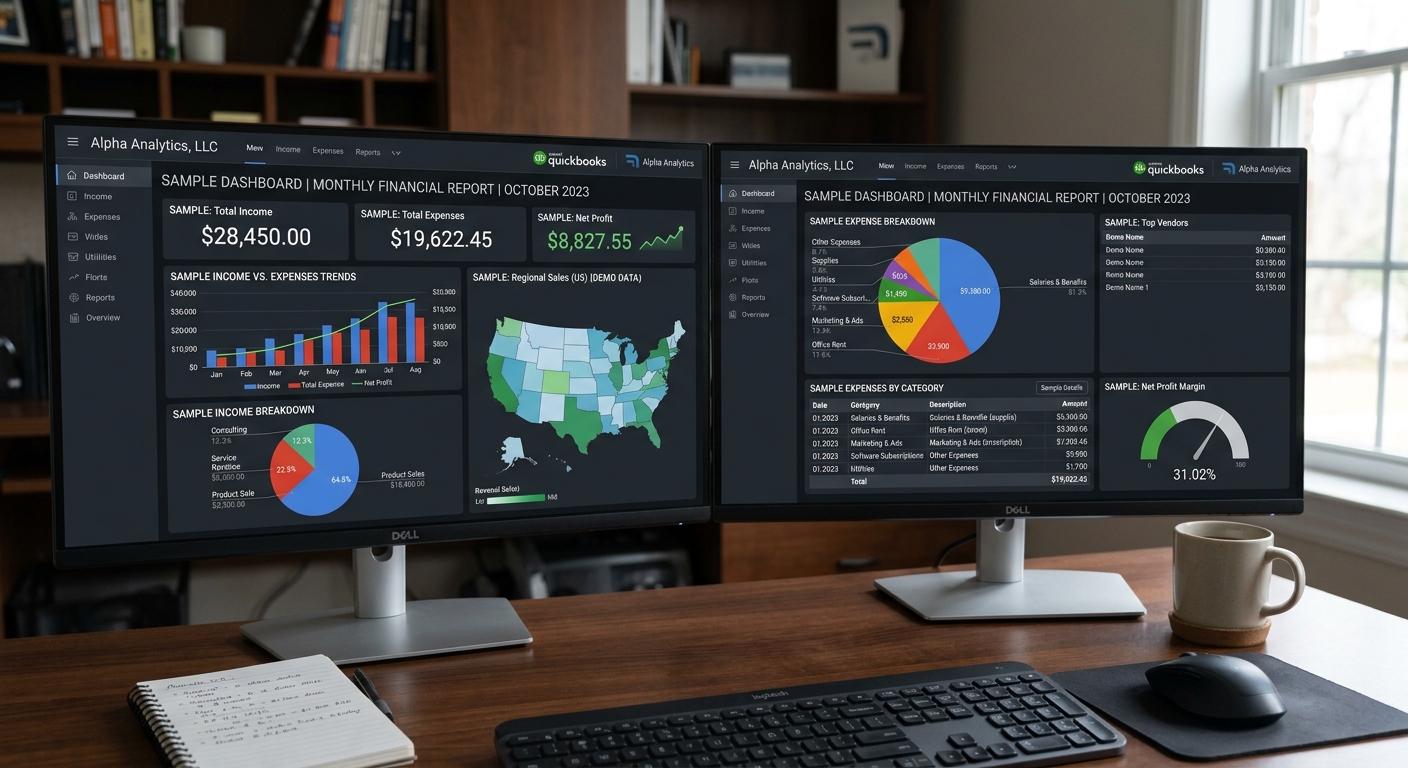
A month-end report is a set of financial statements and summaries prepared after closing your books at the end of each month. It shows how much your business earned, spent, owes, and owns during that period. Most month-end reports include an income statement, a balance sheet, a cash flow statement, and supporting schedules such as accounts receivable and accounts payable aging.
The process of preparing these reports is called the month-end close. It involves recording every transaction, reconciling accounts, and reviewing the numbers so they are accurate before anyone uses them to make decisions.
For small and growing businesses, month-end reports turn daily bookkeeping into clear, usable information. In this guide, Mergix Accounting, an accounting firm in Denver serving businesses across Colorado, explains why they matter, what they include, and the exact steps to prepare them.
Why are month-end reports important?
Month-end reports are important because they give business owners accurate, timely numbers to manage cash, control costs, stay compliant, and plan for growth. Waiting until year-end to review your finances means problems can grow for 12 months before anyone notices them.
Here are the main benefits:
- Better decision-making. You see which products, services, or clients are profitable while there is still time to act.
- Healthy cash flow. Regular reports show when cash is running low, which invoices are overdue, and which bills are coming due.
- Early error and fraud detection. Monthly reconciliations catch duplicate payments, missing deposits, and unauthorized transactions quickly.
- Easier tax compliance. Clean monthly books make tax filings faster and reduce the risk of penalties from late or incorrect returns.
- Faster year-end closing and audits. When every month is already reconciled, the annual close becomes a short review instead of a stressful catch-up project.
- Stronger credibility with banks and investors. Lenders and investors expect current, consistent financial statements before approving loans or funding.
- Budget tracking. Comparing actual results to your budget each month helps you adjust spending before small overruns become big losses.
What reports are included in a month-end report package?
A standard month-end package includes the income statement, balance sheet, cash flow statement, and aging reports for receivables and payables. Many businesses also add a budget-versus-actual report and a short management summary.
| Report | What it shows | Key question it answers |
|---|---|---|
| Income statement (profit and loss) | Revenue, expenses, and net profit for the month | Did we make money this month? |
| Balance sheet | Assets, liabilities, and equity as of month-end | What do we own and owe right now? |
| Cash flow statement | Cash coming in and going out from operations, investing, and financing | Where did our cash go? |
| Accounts receivable aging | Unpaid customer invoices grouped by days outstanding | Who owes us, and for how long? |
| Accounts payable aging | Unpaid supplier bills grouped by due date | What do we need to pay, and when? |
| Budget vs. actual | Actual results compared to the monthly budget | Are we on track with our plan? |
| Bank reconciliation | Book balance matched to the bank statement | Do our records match the bank? |
How do you prepare month-end reports? (Step by step)
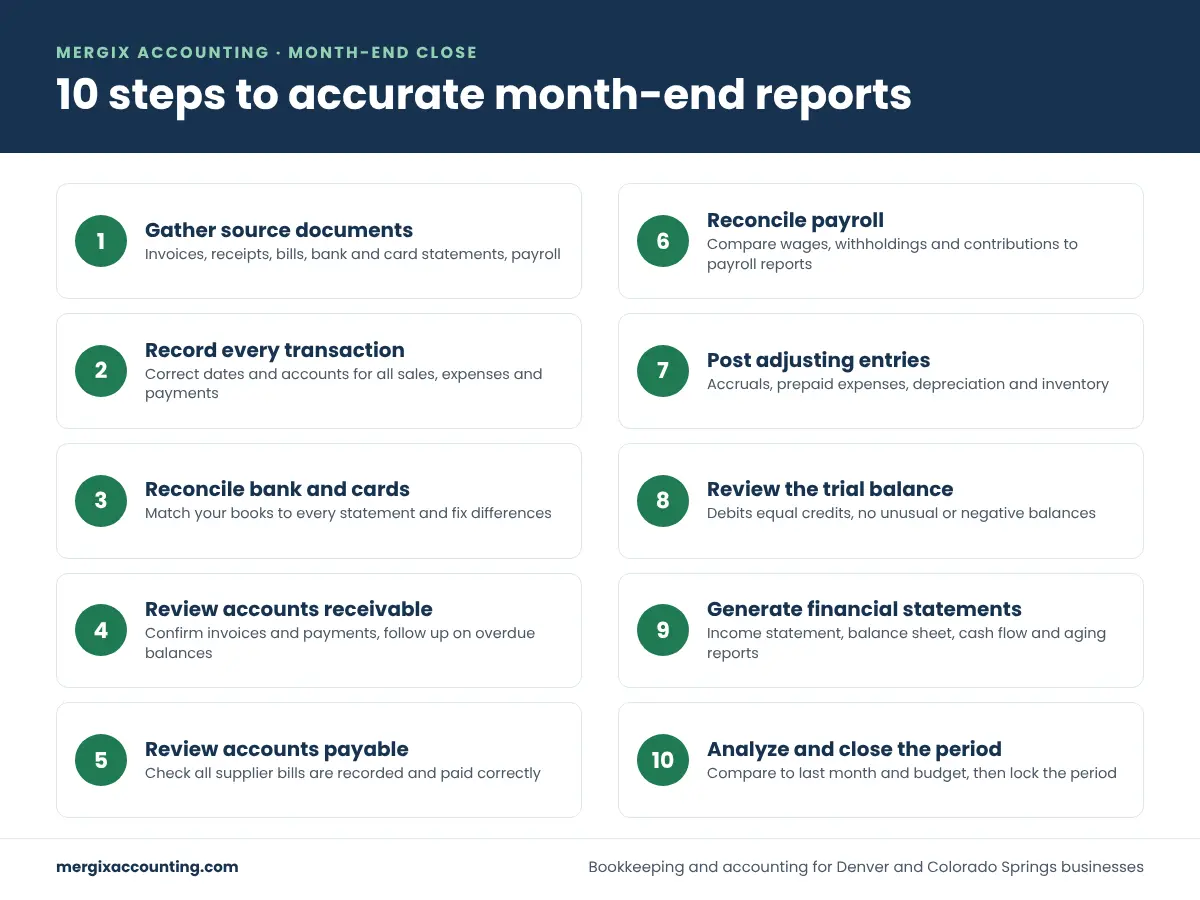
To prepare month-end reports, record all transactions, reconcile your accounts, post adjusting entries, review the trial balance, generate the financial statements, then analyze and close the period. Follow these 10 steps each month:
- Gather all source documents. Collect sales invoices, receipts, supplier bills, bank and credit card statements, payroll records, and petty cash vouchers for the month.
- Record every transaction. Make sure all sales, purchases, expenses, and payments are entered in your accounting system with the correct dates and accounts.
- Reconcile bank and credit card accounts. Match every transaction in your books to your bank and card statements. Investigate and correct any differences.
- Review accounts receivable. Confirm that all customer invoices and payments are recorded. Follow up on overdue balances and note any that may be uncollectible.
- Review accounts payable. Check that all supplier bills received are recorded and that payments match what was actually paid.
- Reconcile payroll. Compare payroll expenses, withholdings, and government contributions in your books against your payroll reports.
- Post adjusting entries. Record accruals, prepaid expenses, depreciation, and inventory adjustments so the month reflects income earned and expenses incurred.
- Review the trial balance. Check that debits equal credits and look for unusual balances, such as negative cash or accounts that changed sharply from last month.
- Generate the financial statements. Run the income statement, balance sheet, cash flow statement, and aging reports from your accounting system.
- Analyze results and close the period. Compare results to last month and to your budget, write a short summary of key changes, then lock the period so no one can accidentally edit closed transactions.
How long should a month-end close take? Many small businesses aim to finish within 5 to 10 business days after month-end. A consistent checklist and up-to-date daily bookkeeping can shorten this significantly.
Month-end close checklist
Use this quick checklist to confirm nothing is missed:
- ✓ All sales and expense transactions recorded
- ✓ Bank accounts reconciled
- ✓ Credit card accounts reconciled
- ✓ Accounts receivable reviewed and overdue invoices followed up
- ✓ Accounts payable reviewed and unpaid bills confirmed
- ✓ Payroll and government contributions reconciled
- ✓ Accruals, prepayments, and depreciation posted
- ✓ Inventory counted or adjusted
- ✓ Trial balance reviewed for errors
- ✓ Financial statements generated and reviewed
- ✓ Management summary written
- ✓ Accounting period locked
What are common month-end reporting mistakes?
The most common month-end mistakes are skipping reconciliations, mixing personal and business transactions, and missing accruals. Watch out for these:
- Skipping bank reconciliations. Unreconciled accounts hide errors and make every report less reliable.
- Mixing personal and business expenses. This distorts profit and creates problems during tax filing.
- Ignoring accruals. Recording expenses only when paid can make one month look too profitable and the next look like a loss.
- Leaving periods unlocked. Edits to closed months change reports that were already shared or used for decisions.
- Generating reports without reviewing them. Numbers that are produced but never analyzed provide no value to the business.
Frequently asked questions about month-end reports
What is the difference between month-end close and month-end reporting?
The month-end close is the process of recording, reconciling, and adjusting your accounts. Month-end reporting is the result: the financial statements and summaries produced after the close is complete.
Do small businesses really need month-end reports?
Yes. Small businesses often have thinner cash reserves, so spotting a cash shortfall or unprofitable product one month earlier can make a real difference. Monthly reports also make tax season and loan applications much easier.
Who should prepare month-end reports?
Month-end reports are usually prepared by a bookkeeper, an accountant, or an outsourced accounting firm. Business owners should review them each month, even if someone else prepares them.
What software is used for month-end reporting?
Common options include QuickBooks, Xero, and other cloud accounting systems. These tools automate bank feeds, reconciliations, and report generation, which shortens the close.
What is a bank reconciliation in month-end closing?
A bank reconciliation compares the cash balance in your accounting records to your bank statement. Any differences, such as uncleared checks or missing deposits, are identified and corrected so your cash balance is accurate.
Can I outsource month-end reporting?
Yes. Many businesses outsource their month-end close to an accounting firm. For Colorado businesses, working with local accountants in Colorado gives you accurate, on-time reports without hiring a full-time in-house accountant.
Key takeaway
Month-end reports give you a clear, accurate picture of your business every 30 days, so you can manage cash, stay compliant, and grow with confidence. A consistent close process, built on reconciliations and a simple checklist, turns bookkeeping into decisions.
Let Mergix Accounting handle your month-end close
Closing the books every month takes time, attention to detail, and accounting know-how. As an accounting firm in Denver and Colorado Springs, Mergix Accounting helps businesses prepare accurate, on-time month-end reports so owners can focus on running and growing their business.
In this article
Need help closing your books each month?
Our Denver accounting firm prepares accurate, on-time month-end reports for businesses across Colorado.